Introduction
Satellite communication has revolutionized the means by which individuals, companies, researchers and amateur radio enthusiasts obtain essential weather and environmental data. One of the most important elements of any satellite receiving station is a good antenna, which can efficiently pick up weak satellite signals. If you are searching for something reliable, the Quadrifilar Helix Antenna by RF Army is a great choice.
Specifically designed as a 137 MHz Antenna, this premium Weather Satellite Antenna offers outstanding Right-Hand Circular Polarization (RHCP) and is appropriate for receiving signals from NOAA weather satellites and other low Earth orbit (LEO) satellites. RF Army supplies trustworthy antenna solutions built for exceptional performance whether you’re an amateur radio operator, an educational institution, a research organization or a weather enthusiast.
In this detailed guide, learn everything about the Quadrifilar Helix Antenna, how it works, its advantages, uses, installation, and why RF Army is becoming a trusted name in satellite communication equipment.
What is a quadrifilar helix aerial?
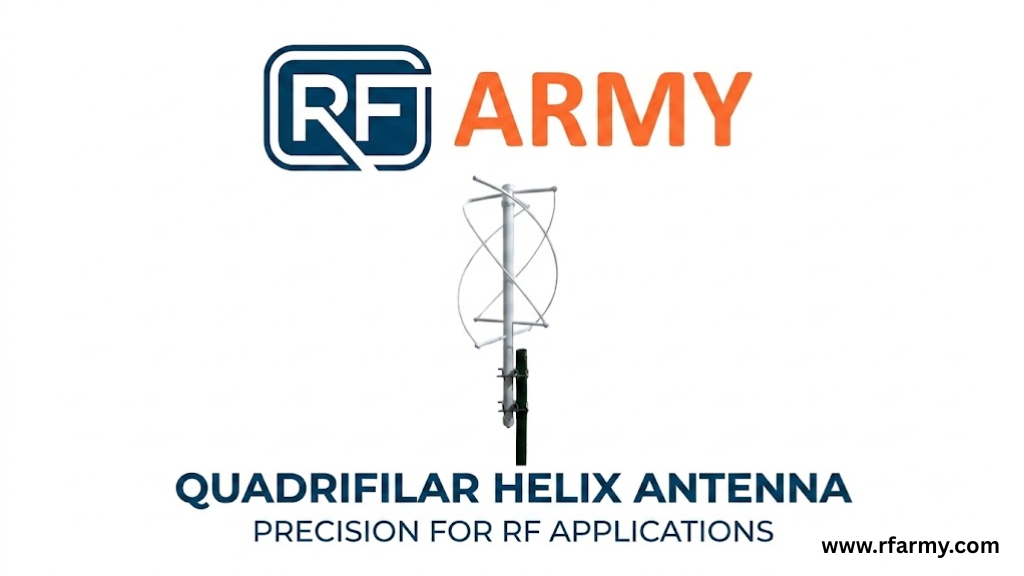
A Quadrifilar Helix Antenna (QFH Antenna) is a particular antenna consisting of four helically coiled conducting elements around a central support structure. The special design of the antenna allows to receive circularly polarized signals from almost all directions with the same efficiency.
The Quadrifilar Helix Antenna delivers great omni-directional coverage compared with conventional directional antennas. Given that weather satellites are always moving across the sky, continual reception is a must. The QFH offers a steady signal intensity without the need to employ a rotator or tracking mechanism.
The RF Army Quadrifilar Helix Antenna is optimized to be a 137 MHz Antenna and so it is the optimum choice for satellite weather monitoring applications.
Why Should I Use a 137 MHz Antenna?
The 137 MHz antenna frequency band is commonly utilized by weather satellites, especially the NOAA satellites that broadcast Automatic Picture Transmission (APT) signals.
If you choose for a specialized 137 MHz antenna, there are a few benefits:
- Optimized frequency capability
- Improved signal-to-noise ratio
- Better reception of satellite signals
- Fewer interruptions
- Weather satellites deliver better image quality
- All weather reliability improved
Each antenna is designed by RF Army experts for the best reception over the whole 137 MHz weather satellite band.
Why You Need a Weather Satellite Antenna
A Good Weather Satellite Antenna is required to get reliable Satellite Images and Environment Data.
The weather satellites of today give us:
- Cloud movement tracking
- After the cyclone
- Weather prediction
- Rainfall forecasting
- Temperature analysis. 2.
- Observations of the ocean
- Follow the climate
A poorly built antenna can lose weak signals during satellite passes. The RF Army’s Quadrifilar Helix Antenna ensures a solid reception during the satellite’s orbit, reducing signal fading to a minimum.
RF Army Quadrifilar Helix Antenna Features
The RF Army Quadrifilar Helix Antenna is built for performance and ruggedness.
- Excellent Circular Polarisation
Supports Right-Hand Circular Polarization (RHCP) same as NOAA weather satellite broadcasts.
- 137MHz Performance Optimized
Specifically designed for the 137 MHz satellite frequency.
It receives messages from satellites anywhere in the sky with no mechanical tracking.
Constructed of corrosion-resistant materials for permanent outdoor installation.
Simple mounting design for rapid deployment on rooftops, towers or masts.
- Reliable signal reception
Keeps good reception even in difficult weather conditions.
The careful design of parts lowers signal attenuation.
Uses of the Quadrifilar Helix Antenna
The RF Army Quadrifilar Helix Antenna is useful for a variety of businesses and users.
NOAA Weather Satellite Images Live.
Perfect for SDR receiver users interested in satellite communications.
QFH antennas are used in satellite communication research in universities and engineering institutes.
- Research in Environmental
Gather weather and environmental information.
Get weather info helpful for emergency preparedness.
- Satellite Ground Stations
Ideal for modest satellite receiving systems.
Perfect for academic and government research.
Benefits of Choosing RF Army
RF Army has grown to be a trusted professional maker of RF communication solutions.
Reasons to choose RF Army:
- Good manufacturing practices
- Precision engineering
- Excellent signal performance.
- Quality Tested Products
- Dependable customer support
- Competitive pricing
- Outdoor rugged construction
- Ongoing development of new products
Whether you’re building your first satellite receiving station or upgrading an existing system, RF Army has reliable options.
How the Quadrifilar Helix Antenna Works (QHA)
The antenna is made of four helical conductors grouped around a central support tube.
The weather satellite emits RHCP signals and each helix receives part of the signal. These signals add in phase to give very good omnidirectional reception.
Due to this design:
- Reduces fading of signal.
- Maintains circular polarization.
- Reception is stable throughout during the pass of the satellite.
- You don’t need an antenna rotator.
Thus the Quadrifilar Helix Antenna is one of the greatest solutions for reception of weather satellites.
Tips for Installation
Good installation makes a big difference in reception quality.
Mount the antenna higher above any nearby buildings or trees.
- Use High Quality Coaxial Cable
Low loss coaxial cable reduces the signal loss.
Make sure the antenna is secure in heavy winds.
- Avoid Electrical Interference
Do not place the antenna near power lines or electrical equipment.
Seal connectors to avoid moisture damage.
Maintenance Advice
RF Army antennas require little maintenance, however periodic inspection will keep them performing at their best.
Suggested maintenance:
- Clean the antenna from time to time.
- Check cables are connected.
- Tighten the mounting hardware.
- Change damaged coax cables.
- Remove any rusting present.
Proper maintenance keeps antenna life going.
Reasons Why RF Army Is The Best Choice
At RF Army we are committed to provide innovative, reliable and affordable high quality RF communication devices.
Customers trust the RF Army because:
- Manufacturing quality
- Antenna performance shown
- Technical know-how
- Customer Satisfaction Survey
- Reliable post-sales support
Whatever you require, from a Quadrifilar Helix Antenna, 137 MHz Antenna to a premium Weather Satellite Antenna, RF Army has solutions for reliable performance.
Conclusion
If you are serious about receiving satellites, investing in a premium Quadrifilar Helix Antenna is one of the best things you can do. The RF Army solution is a dedicated 137 MHz Antenna and is designed to give great performance for all Weather Satellite Antenna applications.
With features such as omnidirectional coverage, circular polarization, sturdy construction and dependable signal reception, it’s a perfect fit for amateur radio operators, researchers, educational institutions, weather enthusiasts and satellite monitoring experts.
RF Army is built on quality, innovation and client happiness, which is why we built an antenna designed to provide you with reliable performance in harsh conditions. Improve your satellite receiving station now with the RF Army Quadrifilar Helix Antenna and get better, stronger and more reliable weather satellite coverage.